
Cynicism
More than just a reaction. (The Bus 8.13)

Welcome aboard The Bus!
The Stop
To the contemporary mind, ‘cynicism’ is the belief that people are inherently insincere and only interested in themselves. In today’s world - and certainly in our current timeline - this makes perfect sense, and in many ways I fully agree and am certainly cynical. After all, what more reason to be cynical do you need than watching the Republicans flail about in their pathetic attempts to curry favour with Dear Leader? It’s no wonder thinking people are cynical, but as I cannot allow this kakistocracy of lickspittles to hijack the good words, today’s Stop is a brief look at cynicism’s origins in ancient Greek philosophy.1

The classical Greek philosophical school of Cynicism was ‘characterised by asceticism and emphasis on the sufficiency of virtue for happiness (eudaemonia),2 boldness in speech, and shamelessness in action.’ Strongly influenced by the teachings of Socrates, tradition links the school’s origin to Antisthenes (c.445-c.360 BCE), a ‘close companion’ of Socrates who was present at the great philosopher’s death. Antisthenes was notable because he celebrated - despite having no money his ‘wealth:’ his term for being satisfied with ‘what he had’ and his willingness to ‘live in whatever circumstances he found himself.’
Following Antisthenes’s lead, subsequent Cynics mounted a ‘major assault’ on the ancient world’s so-called ‘civilised values,’ believing them inherently false. Their philosophy ‘set courage over against fortune, nature against convention, and reason against passion,’ and their most famous adherent was Diogenes of Sinope (c.400-c.325 BCE). Fully committed to living by his beliefs, Diogenes believed human life had been ‘made easy by the gods,’ and that we’d ‘lost sight of this through seeking after honeyed cakes, perfumes, and similar things.’ In addition to following previous Cynics’ teachings on self-sufficiency, Diogenes amplified their inherent ‘disregard for pleasure’ into an extreme form of asceticism.
Believing that with ‘sufficient training’ a life lived according to nature could be happy, Diogenes modelled his behaviour after that of animals. He rejected a life of comfort, resided in a ‘wine cask, ate whatever scraps he came across,’ and after seeing a boy drink from cupped hands, threw his own cup away so he could live more frugally. His behaviour was crude - when caught masturbating in the market-place, his only comment was that it was a shame hunger could not be as easily satisfied. He eventually died from eating a raw octopus (in an ‘attempt to prove a point about the unnaturalness of cooking’), but he genuinely desired to replace what he saw as the ‘debased standards of custom’ with the superior standards of nature. Because of his willingness to live as ‘natural’ as possible, he was called a Cynic - from the Greek for ‘dog’ - because in his behaviour he was as ‘shameless as a dog’.
In one story, Diogenes carried a lighted lamp through the city’s streets in broad daylight in a futile search for a ‘honest human,’ suggesting those he did see were ‘so corrupted that they were no longer really people.’ His insistence on virtue - and a belief that virtuous behaviour can be trained - meant Diogenes believed the ‘simple life not only freed one from unnecessary concerns,’ but was essential to virtue. He condemned love of money, praised good men, and emphasised the virtues of frugality. Yes, he was rather extreme, but doesn’t some of that sound … right?
The Detour
Today’s Detour is to The Price of Progress, a short (8:20) video by Salaryman Tokyo who documents his 90-minute daily commute into Tokyo. For someone who gets annoyed when his 17-minute drive to work becomes any longer, watching this was a nightmare. It’s certainly an interesting watch, and - in the language of the filmmaker - a sobering ‘glimpse into late stage capitalism, where time is the only thing we can’t afford to lose.’
The Recommendation
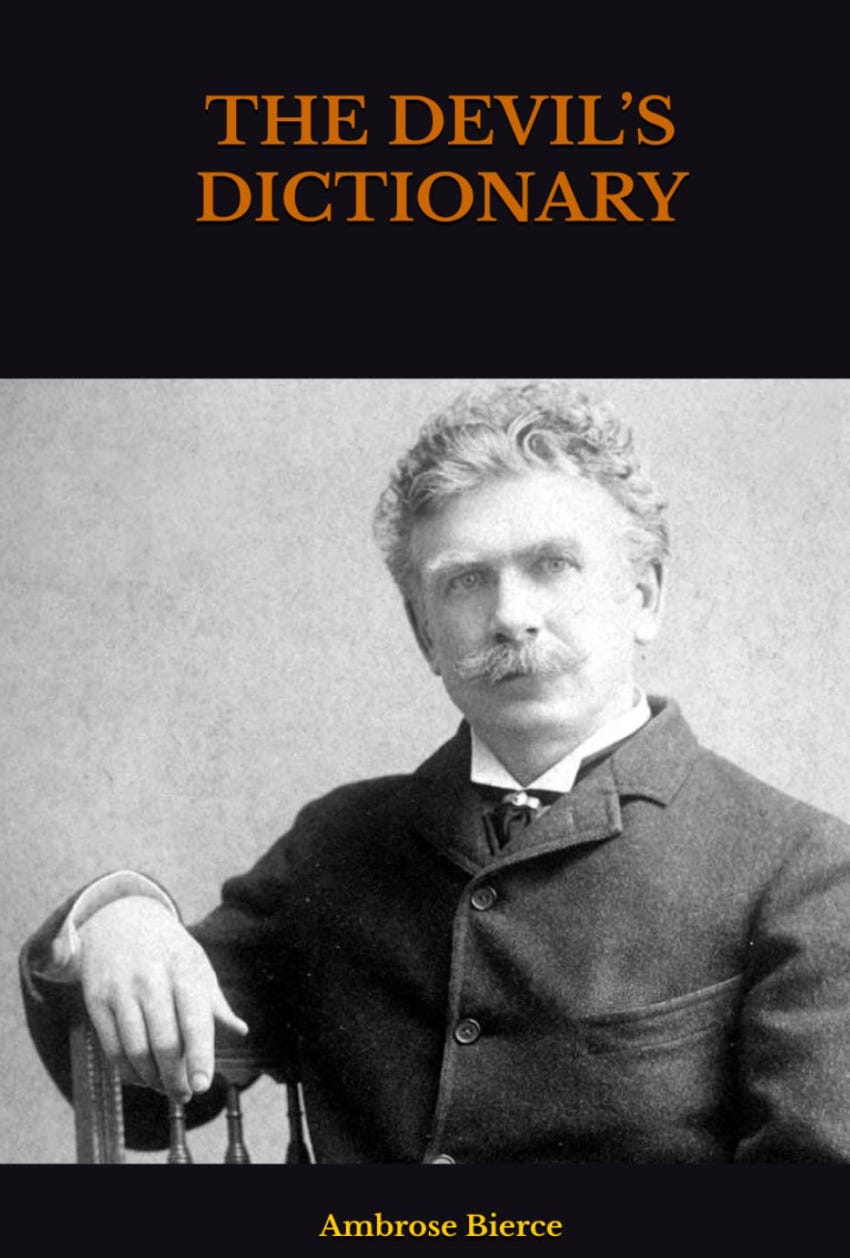
Today’s Recommendation is Ambrose Bierce’s The Devil’s Dictionary.3 A satirical dictionary of common words with humorous, satirical and cynical definitions, the book - a collection of 30 years’ worth of magazine and newspaper instalments - was first published in 1906 as, appropriately for today’s Stop, the The Cynic’s Word Book. You can obviously purchase it from a local bookstore or check it out from your library, but it’s also available online at Project Gutenberg: The Devil's Dictionary.
The Sounds
Today’s playlist - staying true to today’s Stop - is composed of five rather cynical tracks:4 ‘Michael Jackson’ (Negativland, 1987), ‘Eve of Destruction’ (Barry McGuire, 1965), ‘Opportunities (Let’s Make Lots of Money)’ (Pet Shop Boys, 1986), ‘Common People’ (Pulp, 1995) and ‘My Iron Lung’ (Radiohead, 1995). Enjoy!
The Thought
Today’s Thought is from Ambrose Bierce’s The Devil’s Dictionary:
‘CYNIC, n. A blackguard whose faulty vision sees things as they are, not as they ought to be. Hence the custom among the Scythians of plucking out a cynic’s eyes to improve his vision.’
If you have a thought on this Thought - or any part of today’s issue - please leave a comment below:
And that’s the end of this Stop - I hope you enjoyed the diversion!
Thanks to all Bus Riders! Whether you ride in the front, middle, back or the cool-kid seats, your interest and support is truly appreciated. If you like The Bus, please SHARE it with a friend or two.

If you haven’t climbed aboard The Bus, please do!

Until the next Stop …
Sources for today’s Stop include Ancient Ethical Theory (Stanford Encyclopaedia of Philosophy) Audi, Robert, gen. ed., The Cambridge Dictionary of Philosophy, 2nd Ed., Cambridge: Cambridge University Press, 1999, and Hondrich, Ted, ed., The Oxford Companion to Philosophy, 2nd Ed., Oxford: Oxford University Press, 2005.
For more about Eudaemonia, see The Bus 1.34 (1 August 2022): Eudaemonia.
Bierce is probably best known to most Bus Riders as the author of the frequently anthologised short story ‘An Occurrence at Owl Creek Bridge’ (1890). Considered by Kurt Vonnegut as the ‘greatest American short story,’ I first became aware of it in the 5th grade when we were shown a silent film version of it (The Bridge (1929)) in class one day. I have no idea why this was on the curriculum or what the relevance was, but watching that film (along with a lot of others they showed us) certainly changed my view of the world. If you’ve not read it, you definitely should. And check out the film, too (it’s only 10 minutes long).
The McGuire track is by far the weakest of these five; I’ve only included it because several music reviews list it as one of the ‘most cynical songs ever written’ - largely as it was released in the middle of the ‘peace-and-love’ 1960s. It’s definitely not Scott McKenzie. The others are great, though - my personal favourite being the Negativland track, but I’ve always liked their stuff.