
Robert Hunter
Lyrical Genius (The Bus 8.40)

Welcome aboard The Bus!
ORIGINALLY PUBLISHED (4.39) 5 February 2024
The Stop
Robert Hunter (1941-2019) was an American singer-songwriter, translator, poet and lyricist best known for his extensive work with the Grateful Dead. Hunter's lyrics contributed to making the Grateful Dead into a ‘countercultural touchstone,’ and he took great pride that the band’s fans would spend hours analysing them. The New York Times referred to his ‘deeply literary’ songs as being responsible for differentiating the Grateful Dead’s music from mainstream popular music, and Rolling Stone noted that - as one of ‘rock's most ambitious and dazzling lyricists, Hunter was the literary counterpoint to the band’s musical experimentation.’1
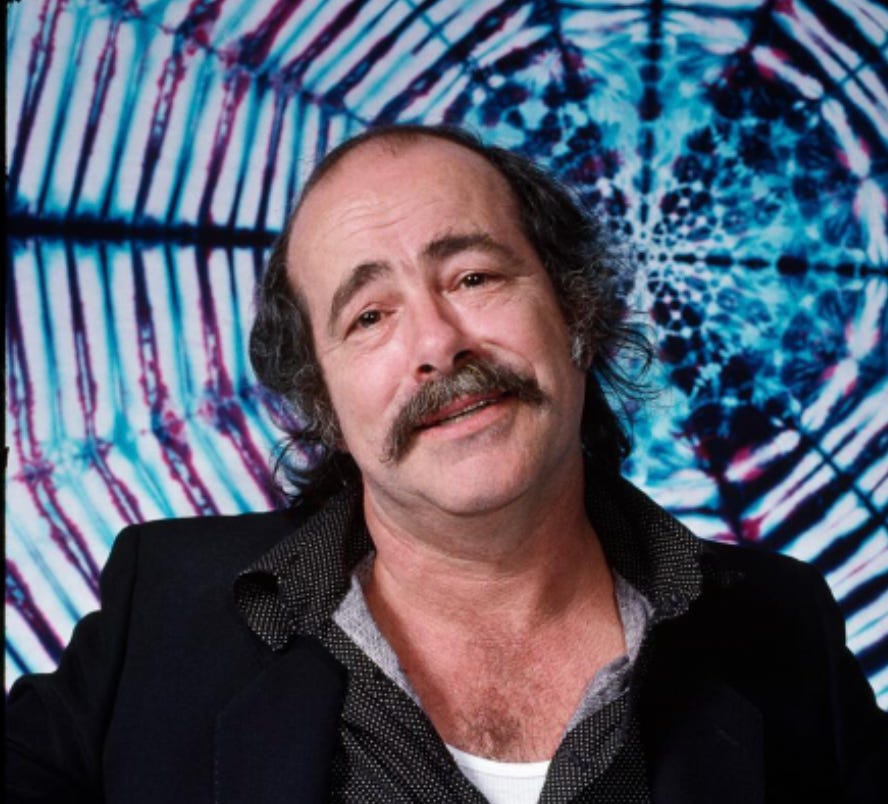
Born Robert Burns in Arroyo Grande, California, when he was seven his alcoholic father deserted the family and as a young boy Hunter spent several years in the foster system, a peripatetic existence which led him to seek stability and refuge in books. After a few years he was reunited with his mother who had married a McGraw-Hill publishing executive - Norman Hunter - who adopted Robert, gave him his surname and encouraged his writing while providing ‘stability and a literary sensibility to his life’. As a teenager, Hunter attended high school in Palo Alto and learned to play several instruments. When the family relocated to Connecticut, a ‘miserable’ Hunter completed his senior year before attending the University of Connecticut. Dropping out a year later, Hunter returned to Palo Alto, where he served in the National Guard for twelve months.
Palo Alto was also where he met - and quickly became fast friends with - Jerry Garcia.2 Bonding over a shared love of folk and bluegrass music, the two began playing together as a duo called ‘Bob and Jerry’, but this was short-lived because of ‘Hunter's limits as a guitarist and Garcia's ravenous drive to get better.’ Nevertheless, the two remained friendly - a relationship which was only enhanced when they and other members of what would become the Grateful Dead began bonding over the newly-available LSD.
In 1962, Hunter volunteered for a series of psychedelic chemical experiments at Stanford University.3 Unaware the experiments were secretly sponsored by the CIA’s MK-ULTRA programme,4 Hunter was excited by the opportunity to take LSD, psilocybin, mescaline and other substances and report on his experiences. When a friend tried to convince him otherwise, his response - ‘It’ll be fun! I’ll take my typewriter and no telling what’ll come out’ - was realised by his ‘string-of-consciousness rhapsodies’. Hunter’s experience would be the first any of the Grateful Dead had with psychedelic drugs, and his resultant ‘creative surge’ proved to be highly influential on their collective outlook.
After a first album (The Grateful Dead (1967)) of covers and two original tracks, the Grateful Dead began working on what would become their experimental second album, Anthem of the Sun (1968). This included a Hunter-penned song - ‘Alligator’ - which led to an invitation to join the band as their official lyricist. Hunter and Garcia wrote every track on the third album, Aoxomoxoa, including ‘China Cat Sunflower’ which became a popular addition to the band’s repertoire for the rest of its career. Hunter's relationship with the band grew until he was officially a non-performing band member.5
After Aoxomoxoa, the band changed its focus from a purely experimentalist/psychedelic approach towards what would become their unique combination of Americana and country music. This aesthetic featured strongly in their next two albums - American Beauty and Workingman’s Dead (both 1970) - which together included some of Hunter’s most successful and long-lasting songs: ‘Uncle John’s Band’, ‘Casey Jones’, ‘Cumberland Blues,’ ‘Box of Rain,’ ‘Friend of the Devil,’ ‘Ripple,’ ‘Truckin’,’ and ‘Sugar Magnolia.’ Living and touring with the band, Hunter would sometimes write the lyrics while the others composed the music, sometimes write the lyrics to already-completed music, and still other times they’d all work together to create the songs as one mind.
Hunter would continue working with the Grateful Dead, penning numerous tracks on all of their following albums. When Garcia died in 1995 and the Grateful Dead disbanded, he continued to write songs for many artists, including Bob Dylan, Elvis Costello, Jim Lauderdale and Bruce Hornsby. He also toured as an opening act on several of the various band incarnations composed of the surviving members of the Grateful Dead, but health issues meant these would be gradually curtailed until his death at home on 23 September 2019.
Though he never performed with the Dead, Hunter gave it a ‘universe of images, ideas, and tales.’ Populated by a cast of ‘drifters, thieves, rounders, jailbirds, horndogs, vigilantes, and roustabouts,’ Hunter’s songs might have provided ‘few conventional, charting hits,’ but there is no question that he hit ‘lots of home runs.’
The Detour
Today’s Detour is to Dollar Pizza Documentary, a short (7:30) video celebrating the New York pizza slice. It’s an interesting look at a staple food - and a delicious one, too, if my personal experience is anything to go on. There are also some rather profound observations buried amongst the comments, so this is definitely worth a watch. But - warning - you will want a piece of pizza.
The Recommendation
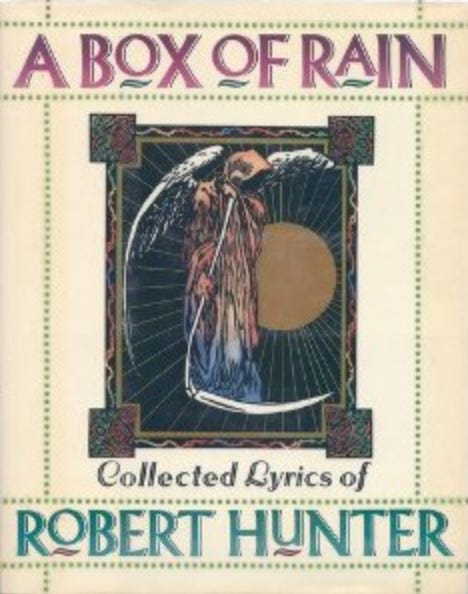
Today’s Recommendation is Robert Hunter’s Box of Rain (1990). A lightly annotated collection of his lyrics, this book - which now appears to be out of print, at least in the version I once owned - is an indispensable resource for anyone interested in Hunter’s lyrics and poetry.
The Sounds
Today’s playlist is a selection of five of my favourite Hunter-penned Grateful Dead tracks:6 ‘China Cat Sunflower’ (Dick’s Picks Vol. 28; 28 February 1973), ‘Wharf Rat’ (Dick’s Picks Vol. 3; 22 May 1977), ‘Brown-Eyed Women’ (Dick’s Picks 29, 21 May 1977), ‘Franklin’s Tower’ (Dead Set, 25 October 1980) and ‘Sugaree’ (One From the Vault, 13 August 1975). Enjoy!
The Thought
Today’s Thought is from Robert Hunter’s lyric for the classic Dead track, ‘Truckin’:7
‘Sometimes the light’s all shining on me/Other times I can barely see./Lately it occurs to me/What a long, strange trip it’s been.’
If you have a thought on this Thought - or any part of today’s issue - please leave a comment below:
And that’s the end of this Stop - I hope you enjoyed the diversion!
Thanks to everyone who subscribes - your interest and support is truly appreciated. If you like The Bus, please SHARE it with a friend or two.
If you haven’t climbed aboard The Bus, please do!

Until the next Stop …
I’m not sure why Robert Hunter hasn’t featured as a Stop before now - I love 1960s counterculture history and he’s a stalwart figure. Along with a host of others who are going to start appearing time and again. But, for now it’s his turn. Sources for today’s Stop include I Will Wait for You (Jim Lauderale), Robert Hunter (NPR), Robert Hunter Gave the Grateful Dead Its Voice (The New Yorker), Robert Hunter (Wikipedia) and McNally, Dennis. A Long Strange Trip: The Inside History of the Grateful Dead and the Making of Modern America. London: Corgi, 2003.
Garcia would become the co-founder, lead guitarist and vocalist for the Grateful Dead. This is the third Dead-related Bus Stop. For more information, see The Bus Issue 1.49 (The Grateful Dead) and Issue 2.8 (John Perry Barlow).
Other participants included the novelist and future Merry Prankster Ken Kesey, and the poet Allen Ginsberg. Both of whom are on the future Bus Stop list.
For more about MK-ULTRA, see The Bus Issue 1.42 (Operation Artichoke).
In 1994, the Grateful Dead was inducted into the Rock and Roll Hall of Fame. Hunter became the first non-playing member of a band to be included in the accolade.
I can’t pretend this was an easy choice - there are SO many Hunter-penned songs, almost all of which are classic Dead tracks. There are also innumerable recordings of these songs floating around, so I’m sure there are ‘better’ versions, but these are the ones that first really caught my ear. If you have a suggestion of a favourite version - of these or another Hunter track - let me know in the comments.
Life’s been a long, strange trip indeed. And long may it be so. Otherwise … what’s the point?!
As a songwriter and someone fascinated with, and deeply in love with, wordplay, I'm ashamed to reveal my complete ignorance of Robert Hunter. My new-found fascination with psychedelics makes this even more pronounced.
You may instruct me on my penance.
Other than that, I am going to track down the book.
Great spotlight on a great lyricist. Thanks